We Keep Us Safe
Minnesota Communities Resist Operation Metro Surge, Part 2: The Resistance

by Molly Todd
The views and opinions expressed in this post are solely those of the author and do not necessarily reflect the views, policies, or positions of the Organization of American Historians.
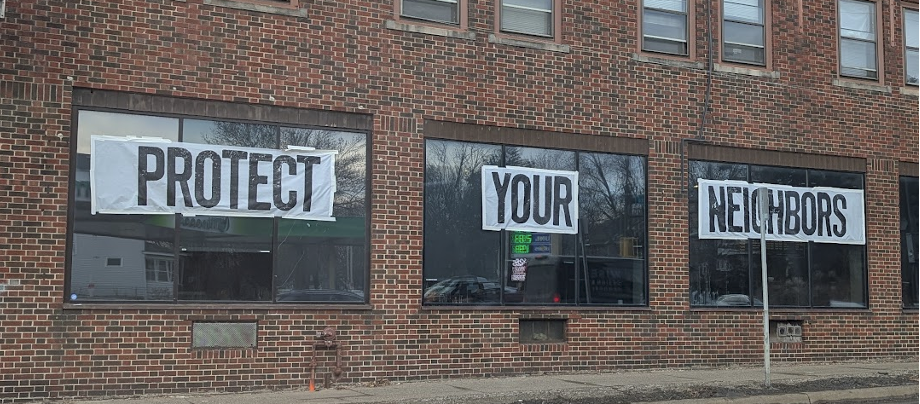
In Part 1 of this post, I explained how Operation Metro Surge—the Department of Homeland Security’s “largest immigration operation ever,” involving some 4,000 federal agents deployed to the twin cities of St. Paul and Minneapolis (and beyond)—parallels the worst of Latin American dictatorships. Poorly trained Immigration and Customs Enforcement officers run roughshod through the cities, abducting and disappearing people, surveilling and threatening community members, and intentionally instilling fear. Federal officials justify this terror with white nationalist rhetoric and deceitful data.
In Part 1, I also described how this terror strikes a personal nerve. As a historian of Latin America, I have spent decades conducting research on—and in the context of—state terror, particularly in El Salvador. As federal helicopters hover over my St. Paul neighborhood and ICE agents begin abducting, disappearing, and murdering my neighbors, I experience many of the hallmarks of vicarious traumatization and burnout described by Erin Jessee, Kimberly Theidon, and other scholars whose work has taken them into dangerous territory. Suddenly, the danger zones of El Salvador and Minnesota merge.
But if I find eerie parallels between the state terror of there/then and here/now, I also find similarities of a more sanguine kind. Like their counterparts to the south, Twin Cities residents have risen into action.
I.
Minnesota
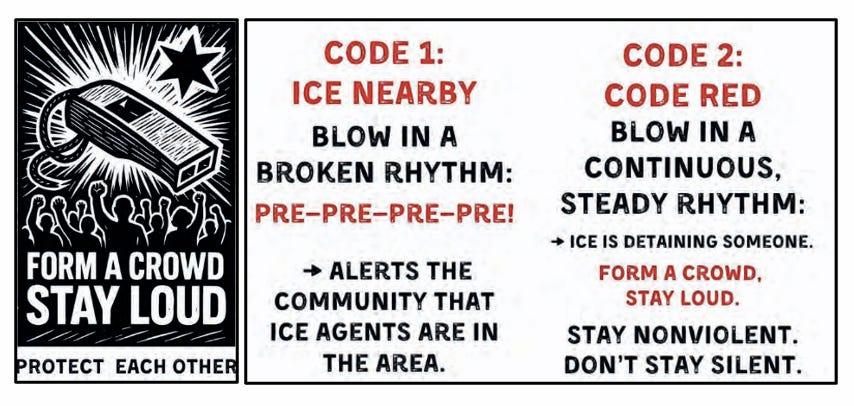
Tucked inside a Little Free Library in a quiet neighborhood of St. Paul is a small zip-top plastic baggie containing an orange whistle on a string and a zine with simple instructions and important phone numbers. “Form a Crowd. Stay Loud,” the instructions exhort.
We do.
Drawing in part from the experiences of residents in Powderhorn Park and contiguous Minneapolis neighborhoods during the hours, days, and weeks following Derek Chauvin’s murder of George Floyd, as well as people in Chicago and Portland who earlier had faced major ICE surges, Twin Cities residents form grassroots defense patrols to protect ourselves and our neighbors. In Target and Home Depot stores, on city streets, at gas stations, outside people’s homes, one whistle blares and soon becomes two whistles, then ten, then fifty. Citizens gather at the site of ICE actions, making noise, recording agents’ actions with cell phones.
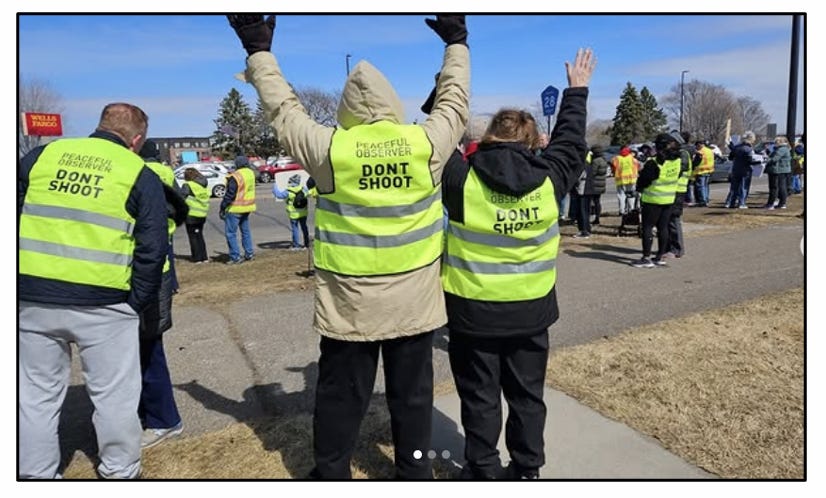
To distinguish ourselves from the intentionally unidentifiable federal agents, we develop uniforms: lanyards with whistles and high visibility vests. (As further evidence of their crooked duplicity, federal agents involved in Operation Metro Surge soon began sporting high viz vests, whistles, and other symbols from local observer groups.) After the murders of Renée Good (by ICE agent Jonathan Ross) and Alex Pretti (by a group of immigration agents, including Border Patrol agent Jesus Ochoa and Customs and Border Protection officer Raymundo Gutierrez) in January 2026, many neighbors emblazed their vests with “Peaceful Observer: Don’t Shoot.”
Argentina
Marguerite Feitlowitz, in her powerful book A Lexicon of Terror, recounted the story of a woman’s abduction from a city bus in Buenos Aires, Argentina, during the dictatorship (1976-1983). While most people remained passive, looking the other way as government agents violently removed her from the bus, one older woman pleaded quietly, almost to herself, “Not by the hair!” Feitlowitz explored how so many citizens went through the dictatorship years “seeing but not knowing.” The military government succeeded in atomizing society to such a degree that a common survival strategy was to keep one’s head down in hopes of avoiding any kind of attention.
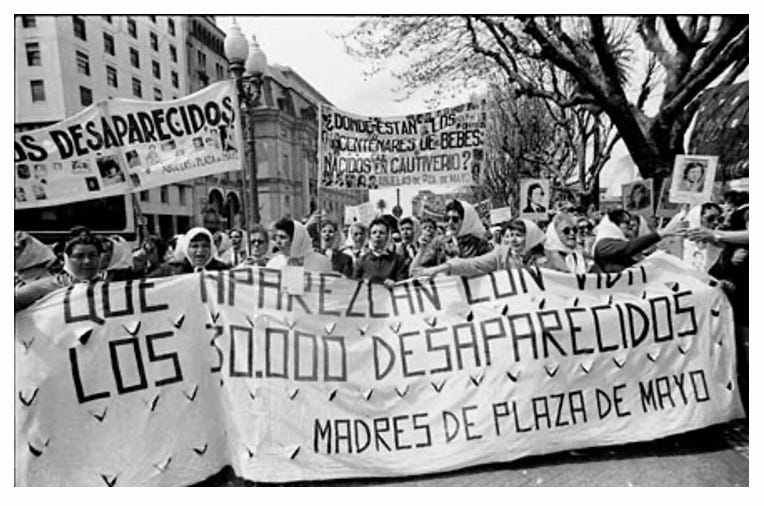
Yet many people risked going public despite their fear. In 1977, at the height of the military dictatorship, a small group of women gathered at the Plaza de Mayo in the heart of Buenos Aires. They carried photographs of their children who had been disappeared by government agents. They wore white headscarves embroidered with the children’s names and the dates they were disappeared. In plain view of government buildings, the women marched in silent, slow circles. They continued this public protest every week after that—Thursdays at 3:30 pm. They continue to this day, foreshadowing the long-term consequences of state terror.
Latin America
Organizations like the Madres de la Plaza de Mayo appeared across Latin America: the Group of Relatives of the Detained Disappeared in Chile (Agrupación de Familiares de Detenidos Desaparecidos); the committee of mothers and family members of political prisoners and disappeared people in El Salvador (COMADRES), and the National Coordinator of Widows of Guatemala (CONAVIGUA), to name just a few. Spurred by state terror—and particularly the abduction and disappearance of family members, friends, and neighbors—these people organized, marched, and protested.
In neither Latin America nor Minnesota do these emergency, front-line observers and advocates put a full stop to state terror. Yet their presence and persistence challenges state abuse of power and complicates state agents’ actions. And by drawing attention to the on-the-ground reality—which quickly travels the world with border-crossers and through mass media and, now, social media pathways—people directly counter the intended clandestinity of state terror.
II.
These challenges deepen as ad hoc emergency actions develop into more organized mutual aid networks that document and share information related to the movement of state agents and their violations of human rights, and provide physical, moral, and spiritual accompaniment to those in need.
Latin America
Churches took a leadership role in responding to state terror. They established offices to collect witness testimonies and other documentation of state violations of human rights, and to provide legal and social support to victims and their families. The Vicaría de la Solidaridad (and its precursors) in Chile and Socorro Jurídico and Tutela Legal in El Salvador, for example, each documented some 50,000 cases. In Brazil, a network of prominent religious figures, lawyers, and others worked for six years to covertly duplicate the military government’s files on political prisoners, spiriting copies out of the country for secure preservation, and analyzing the materials to identify and publicize the systematic use of torture—a process described in terrifying detail by Lawrence Weschler in his now-classic book A Miracle, A Universe.
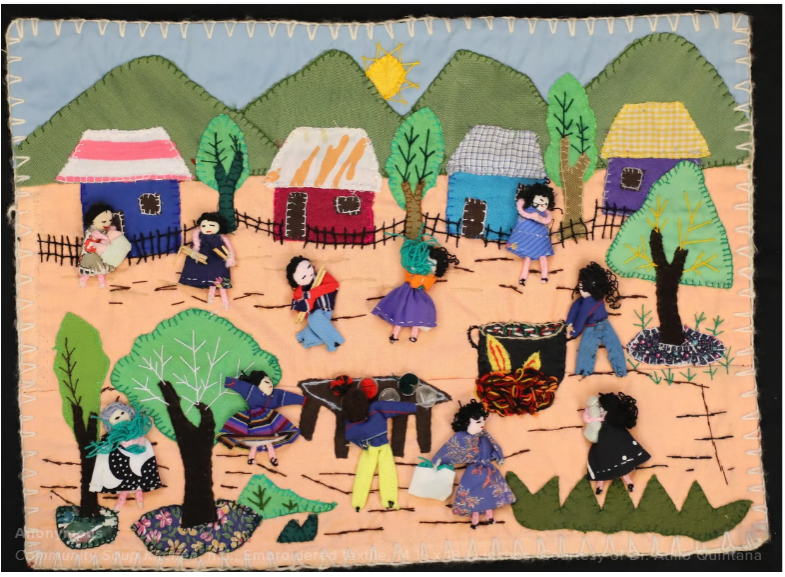
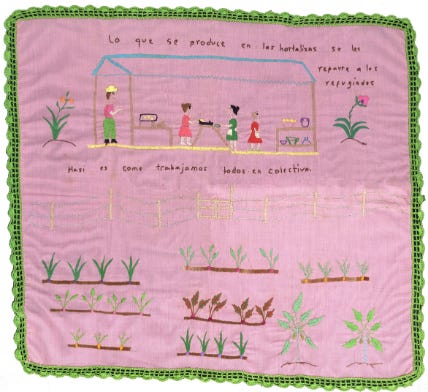
The initiatives of churches and other organizations created spaces where people with similar experiences crossed paths which, in turn, contributed to the formation of new organizations like Co-MADRES, CONAVIGUA, and Madres de la Plaza de Mayo. While these and other groups continued to “make noise,” they also formed workshops to help clothe, feed, and protect each other. In many places, including refugee camps, people documented this collective care in intricate embroideries.
Minnesota
We create patrol networks, assign locations and shifts at schools, language immersion preschools and daycare centers, mosques, and markets established by and catering to Somalis, Latinx, Hmong, and other immigrant groups. Walkers, joggers, and drivers zig-zag through neighborhoods, pause for a while at bus stops and apartment complexes. At the Whipple Federal Building in the historic Fort Snelling—used by the United States as a concentration camp for thousands of Dakota and Ho-Chunk people in the early 1860s—a team stands vigil 24-7. They track the movements of ICE and Border Patrol agents and provide support to people released from detention. Many neighbors drive around offering hot drinks and hand warmers to those on watch duty during the coldest winter months. And, at the Minneapolis-St. Paul International Airport, a dedicated volunteer tracks federal deportation flights, photographing and counting the number of people who are forced aboard and flown out of state. We document incidents and share our photos, videos, audio recordings, and written notes to designated organizations and individuals.
Experienced people bring in trusted newcomers. Training systems emerge, and the network expands. Many attend workshops to become constitutional observers, trauma first aid workers, and street medics. Others go on ride- and walk-alongs with skilled neighborhood patrol personnel, join sessions to learn specific roles in the community self-protection networks. Still others organize neighborhood meet-ups to keep people up to date on the evolving situation and help those new to community advocacy “find their lane.” And still others manage complex systems for providing food aid, rent assistance, and rides to work, school, and medical appointments; host nightly virtual reflection spaces, grief rooms, and collective public screams; organize weekly “cash mobs” to encourage patronage at immigrant-owned restaurants and small businesses; design and execute creative signage campaigns to inform and protest; and create and distribute coloring books to children who can’t leave their homes for fear of being taken away by ICE like 5-year-old Liam Conejo Ramos was.
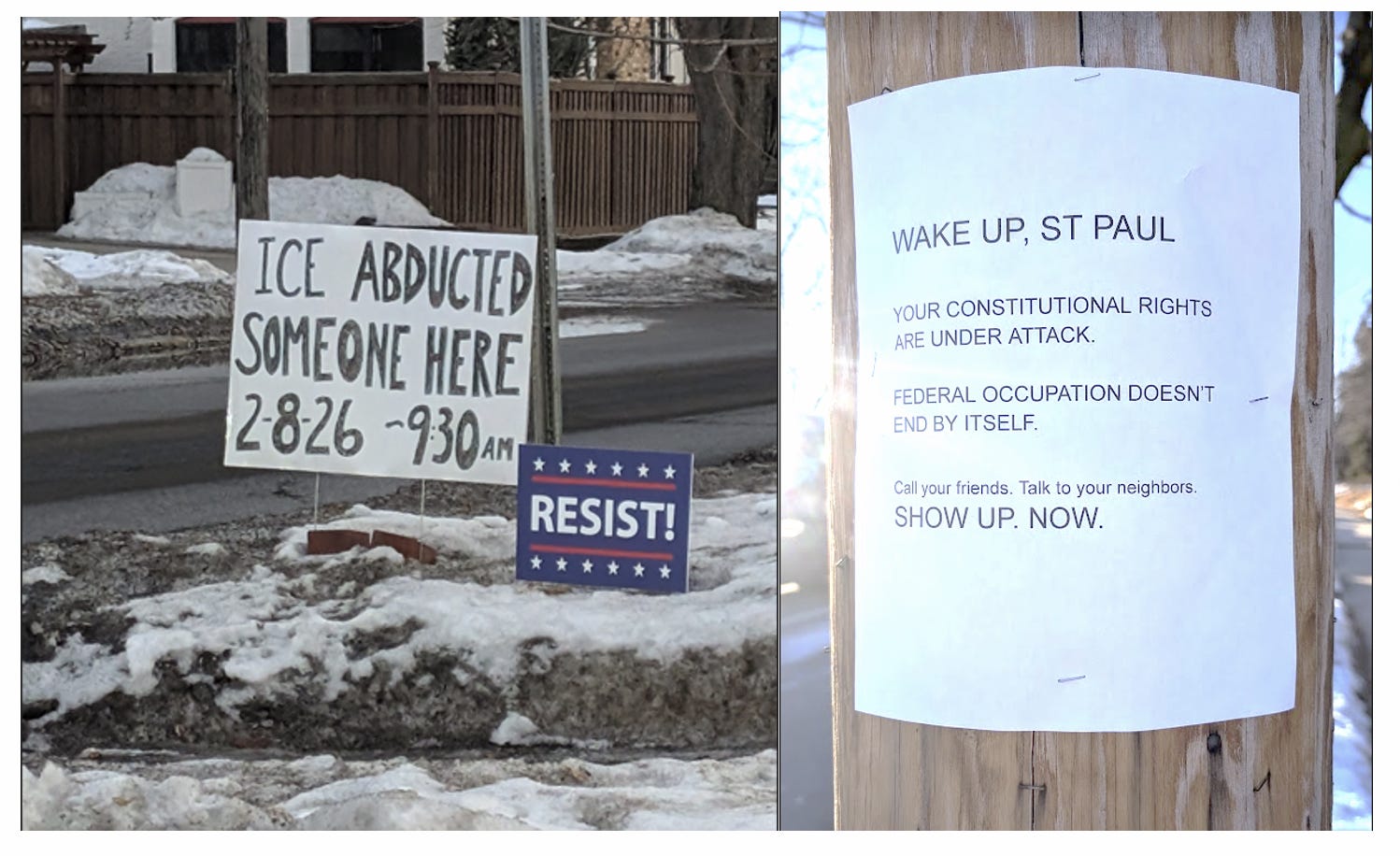
All of this defies state terror by documenting truth in the face of official lies and subterfuge, providing information to families of those abducted and disappeared, creating evidence for legal teams, and accompanying the most vulnerable community members. Coming together in these ways also purposefully counters the social atomization that is an intended effect of state-led violence, thus embodying the memorable anthem-turned-protest-chant created in 1973 by Chileans Sergio Ortega and Quilapayún on the eve of dictatorship: “The people united will never be defeated.”
III.
There are many other parallels between Latin American peoples’ responses to state terror in the mid to late 20th century and Minnesotans’ responses today. Rather than explore those here, however, I want to shift directions and point to a parallel that has not yet come to pass, but that I predict will—because our Latin American neighbors’ experiences prefigure it: even when periods of state terror end, they do not truly end. That is, the social impacts of the violence reverberate for generations to come.
Even when periods of state terror end, they do not truly end. That is, the social impacts of the violence reverberate for generations to come.
In many ways this is not breaking news. Oral histories and traditions from Native American, African American, and Japanese American communities, among others, have long documented this reality, and growing research on epigenetics, historical trauma response, and intergenerational trauma further substantiate it. Indeed, the long-term biological, psychological, and social consequences of state violence are now a key focus of entire fields of scholarship, including transitional justice and memory studies.
But, extending Dr. Bessel van der Kolk’s formulation, even as individual physical bodies keep the score, the social body keeps playing the game. That is, even when state terror continues to cast long shadows over nations, the people continue to organize and mobilize around issues of truth, justice, and accountability.
Latin America
Latin America emerged out of cold war era dictatorships and wars more than a quarter century ago; the last of the region’s conflicts formally ended with the 1996 peace accords in Guatemala. And yet, so many wounds remain raw. In an ongoing search for healing, people continue to document and make evident the state’s role in human rights violations; to search for the truth of what happened to the disappeared, murdered, and state terror survivors; to demand acknowledgement and reparation; and to hold perpetrators accountable for their crimes.
Some post-conflict states established truth commissions to investigate and prepare reports. Some perpetrators have gone to trial. A few have been convicted and imprisoned. It is far more common, however, for the truth to remain hidden and for perpetrators to roam free.
And, so, grassroots efforts continue to exhume the truth, both figuratively and literally.
In 1984, the non-governmental Argentine Forensic Anthropology Team began working to exhume the bodies of people believed to be among those forcibly disappeared by agents of the military dictatorship. This team has since assisted with similar exhumation processes throughout the region, including Brazil, Honduras, Chile, Bolivia, Uruguay, Peru, Guatemala, and El Salvador. In 1992, the Guatemalan Forensic Anthropology Foundation formed with the similar mission to search for and identify victims who were forcibly disappeared during the military dictatorship and internal conflic. In all these places, local residents play key roles in identifying clandestine burial sites and orchestrating exhumations. In El Salvador, where I used to live, this work has been guided by rural villagers who formed Historical Memory Committees. Remarkably, young people—who did not experience state violence directly themselves—observe and, in many cases, assist in this important work.
Other recovery efforts center specifically on young people. In Argentina, the Grandmothers of the Plaza de Mayo have spent decades searching for the children of the disappeared. Thousands of children and youth were kidnapped, and hundreds of babies were born in clandestine prisons, then illegally adopted and raised without knowledge of their true origins. Combining investigative and legal methods with more recent breakthroughs in genetics, the Grandmothers have successfully managed to identify 140 of these children and reconnect them with their biological families. Similar work is underway in Chile and El Salvador.
In some instances, the youth are taking up the struggle directly. One young man who was illegally adopted out of Chile, for example, established Chilean Adoptees Worldwide to raise awareness of this phenomenon and to bring together other children who experienced the same fate. Through Our Parents’ Bones, young Salvadoran-Americans work to uncover the truth about their parents, who were disappeared in El Salvador. And in Argentina, children of the disappeared and their allies carry out grand demonstrations near the homes of known human rights abusers. Known as escraches, these events are designed to publicly shame the individual perpetrators while condemning ongoing, systematic impunity.
The lack of institutionalized national responses in support of the survivors of state violence prompts other public actions as well. In El Salvador, the International Tribunal for Restorative Justice has facilitated at least nine trials in villages throughout the country. At each, a panel of judges from different countries presides while survivors of state violence offer testimony and provide evidence, often identifying perpetrators by name for the first time. At the close of the multi-day event, the judges deliver a verdict against the perpetrators. They then issue a formal report which, among other things, makes recommendations to the state for holding perpetrators accountable, advancing reparations and other forms of acknowledgement, and strengthening human and civil rights institutions.
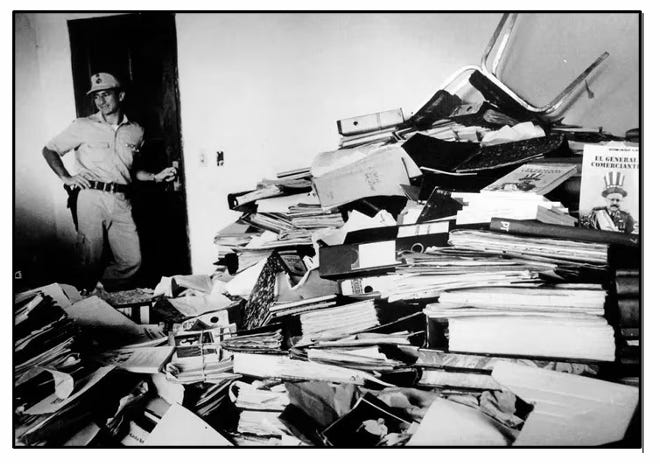
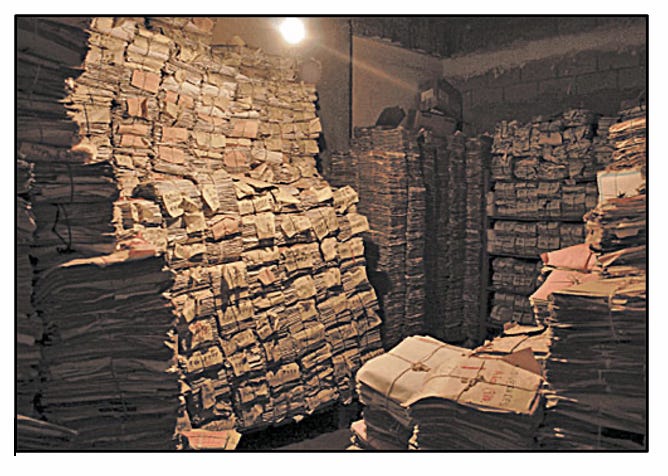
Documentation plays a critical role in these efforts. Testimonies and other materials in the archives of El Salvador’s Tutela Legal, Chile’s Vicaría de la Solidaridad, and similar nongovernmental institutions initially served as foundations for writs of habeus corpus and other legal filings during the dictatorships and/or conflict periods. Later, surprise discoveries of hidden caches of documentation from state security forces provided additional tools in the search for truth and justice. These materials help to locate clandestine graves, which allow forensic anthropologists to exhume human remains and collect additional evidence of the state’s role in massacres and other atrocities. Legal teams and inquiry commissions rely heavily on such documentation in preparing reports and launching national and international cases against perpetrators.
Minnesota/United States
Minnesota has not yet emerged from the violence, despite the fact that federal officials announced a “winding down” of Operation Metro Surge in mid-February. Hundreds of ICE and CBP agents remain in the state—still well above the pre-surge numbers. (In keeping with the current clandestine character of these federal security forces, there are no publicly available, up-to-date numbers of deployed agents. Estimates come from observers on the ground.) Agents continue to whisk individuals and groups off Minnesota streets, and from homes, work places, and courthouses. The number of abductions and people forcibly removed by DHS flights is once again on the rise, per observers’ records.
Minnesotans are not alone. In June, federal immigration agents detained 43,138 people across the country. This is the highest number on record for the current administration and “reveals how US immigration agents are quietly but steadily ramping up operations across the country.” (For more immigration-related data, see the TRAC Reports site.) And as we in the Land o’ Lakes mourn the January murders of Minneapolis residents Renée Good and Alex Pretti, immigration agents continue to brandish and use weapons against people on streets across the country. A little over a week ago, agents shot and killed two more people in Texas and Maine.
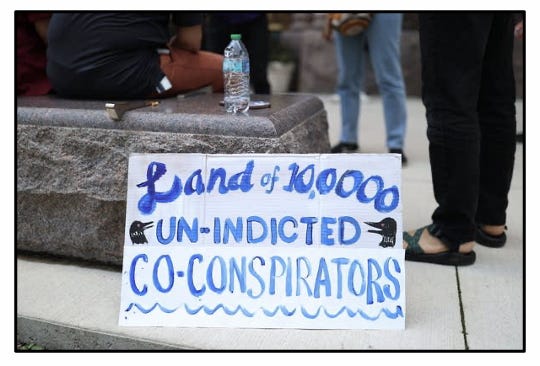
Also on the rise are federal attacks against US citizens who exercise their rights to organize, to speak, and to protest. Earlier this month, federal prosecutors in Minnesota charged 15 people with conspiracy relating to community organizing activities in the context of Operation Metro Surge. This comes on the heels of another mass arrest and trial in Texas; in late June, nine Texans were sentenced to prison terms ranging from 30 to 100 years for activities relating to a 2025 protest at an ICE detention facility.
As these citizens face the courts for protesting ICE agents’ violations of human rights, others are compelled to testify before the House of Representatives in live-streamed hearings, including one entitled “Oversight of the Smithsonian: Radical Revisionism at the National Museum of American History.” Reminiscent of McCarthy-era anti-communist crusades and the televised hearings of the House Un-American Activities Committee, the 2026 hearings and related report “Saving America’s Story: How Ideological Capture at the Smithsonian Institution’s National Museum of American History Erases our Heritage,” seek to publicly brand historians and museum professionals as conspiring against the United States for telling a complex and multi-voiced history of the United States.
While federal officials criminalize wider and wider swaths of society, US citizens and residents continue the struggles to secure our own safety, to protect each other, and to defend the democratic mainstays enshrined in the First Amendment. We have only just begun the struggle for truth, justice, and accountability on behalf of the murdered, the detained and disappeared in the black sites of the carceral system, the men and women tortured, the children and youth used as bait and/or removed from their homes and families, the families separated, and others.
Latin America’s experiences must serve as both warning and inspiration: State terror has an enduring afterlife. So, too, does people-powered organizing and civic action.
Molly Todd is a historian specializing in modern Latin America, transnational human and civil rights activism, and historical memory. She is the founder and principal consultant at Finlinje Studios.