We Keep Us Safe
Minnesota Communities Resist Operation Metro Surge, Part 1: The Terror

by Molly Todd
The views and opinions expressed in this post are solely those of the author and do not necessarily reflect the views, policies, or positions of the Organization of American Historians.
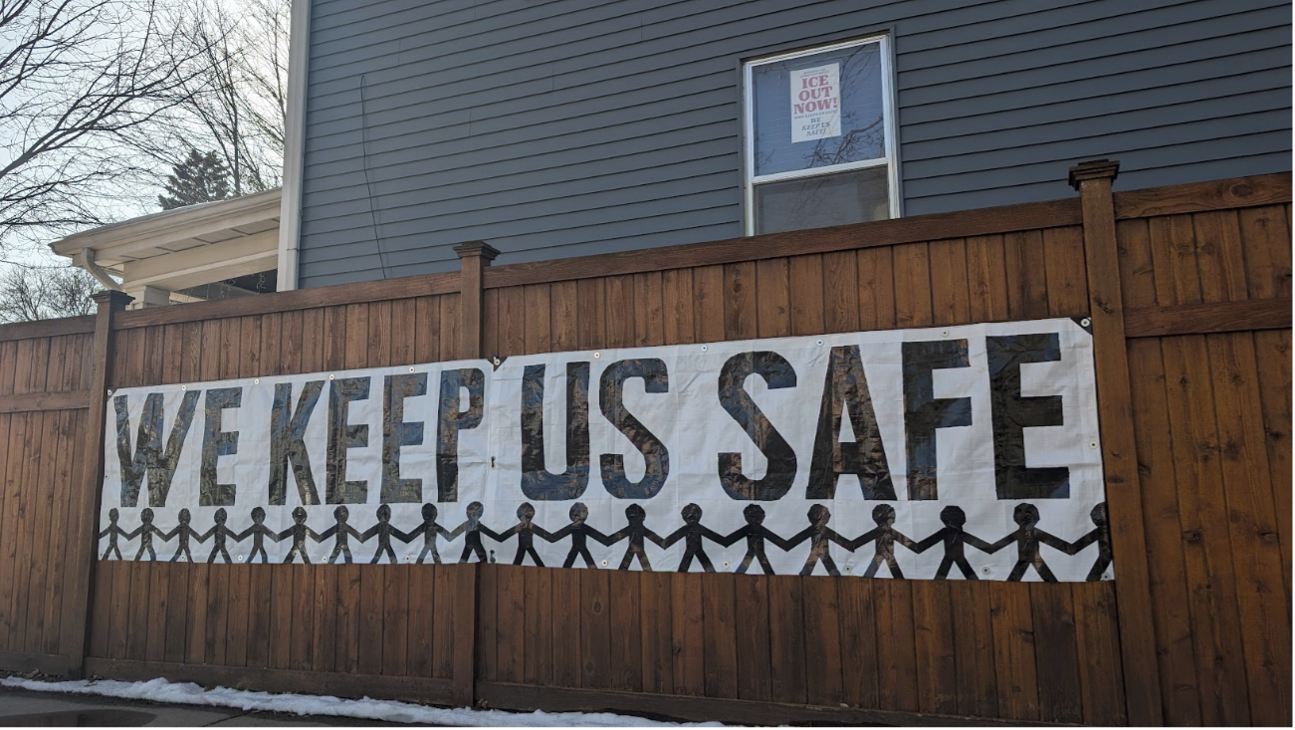
On a freezing cold afternoon in January 2026, a Department of Homeland Security helicopter began hovering over my neighborhood. Muscle memory kicked in; I froze. A flashback: a hot and dusty street of Chalatenango, El Salvador, election day 1999. As an international observer, I am documenting events at this polling site. The peace accords are still young and ARENA, the right-wing ruling party, likes to flex its still-dictatorial muscles. In spite of new laws prohibiting party proselytizing or acts of intimidation at polling sites, ARENA sends a helicopter—provided to the Salvadoran armed forces by the US government during the country’s 12-year conflict (1980-1992). It arrives suddenly, hovers low over the crowded street. Every living being freezes, stares up at the helicopter as the side door slides open. Even I, who did not live the war in my own flesh, fully expect the worst. Rather than a door gunner with his machine gun, we see a soldier with a gigantic zoom lens. As he begins snapping photographs of us, what settles is not relief but a different kind of fear.
For nearly 30 years, I have conducted research on—and in the context of—state terror. As a historian of Latin America, I investigate how US support for authoritarian leaders affects ordinary people. Although trauma is an important part of the story, I am especially interested in documenting how people organize together to survive and to resist. Thus far in my career, most of my field research sites have been “over there,” in Central America. Now, I am “here,” asking the same kinds of questions in my Minnesota hometown.
With Operation Metro Surge—which the Department of Homeland Security touted as the “largest immigration operation ever”—some 4,000 federal agents suddenly descended on the twin cities of St. Paul and Minneapolis. By early January 2025, the scenes I was witnessing paralleled the worst of Latin American dictatorships.
MINNESOTA/ARGENTINA
Sometimes the similarities appear to me slowly, like ghosts rising. Most often, they arrive flash-bang style. All are nightmarish and surreal.
Minnesota
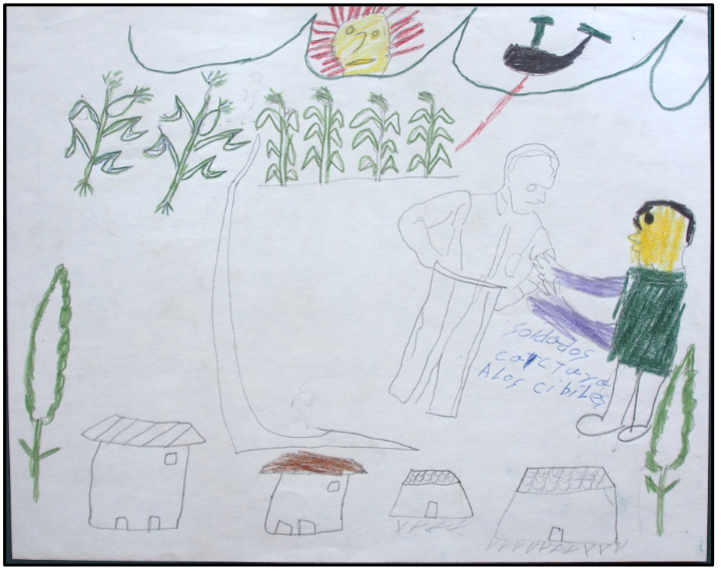
Gangs of men comb our neighborhoods. Wearing full face masks, body armor, and often mirrored sunglasses, they carry assault rifles and other combat gear. They abduct men and women from homes, vehicles, workplaces, hospitals; children from schools. They typically drive SUVs—Chevy Tahoes and Suburbans, Ford Expeditions and Explorers, Dodge Durangos—with heavily tinted windows and plates that are illegible, missing, or mismatched (front and back plates are required by law in Minnesota).
D., a former student of mine, who relocated to Minneapolis about five years ago, shared some thoughts with me on January 12, after an acquaintance—a US citizen—“was dragged from [their] car, beaten, and arrested” by agents. Referring to my seminar on human rights in Latin America, D. said, “I’m very reminded of the symbol of the Ford Falcon with the SUVs, vans, and unmarked vehicles whipping around the city.”
Argentina
Secret service agents, typically in civilian dress and sporting aviator sunglasses and revolvers, abducted people from homes and public places like buses, classrooms, offices, street corners. Their vehicle of choice, the Ford Falcon, became a symbol of terror during the country’s so-called “Dirty War” (1974-1983).
LATIN AMERICA/MINNESOTA
The current US administration has adopted pages directly from the playbook of Latin America’s dictators. The script goes like this: The very survival of the (white, Christian) nation is at stake. We are under attack from internal enemies who are influenced, funded, and even directed by external forces. To save the nation, we must eradicate this internal threat at all costs.
Latin America
State forces enacted extraordinary measures to ferret out “communist subversives” who, officials claimed, were tied to Soviet and Cuban operatives. In the wake of the coup d’etat in Brazil, for example, military leaders issued Institutional Act No. 1 (April 9, 1964), which initiated a slate of “urgent measures destined to drain the communist swamp, whose purulence already had infiltrated” the highest levels of the recently deposed civilian government.
When General Augusto Pinochet came to power in his own coup in Chile in 1973, he publicly justified the ongoing wave of repression: “We cannot just give the sick patient a single injection and then abandon him again. The result would be a relapse.” He continued, “Chile’s liberty will be returned when the country is completely recuperated and the malignant tumor of Marxism has been removed.”
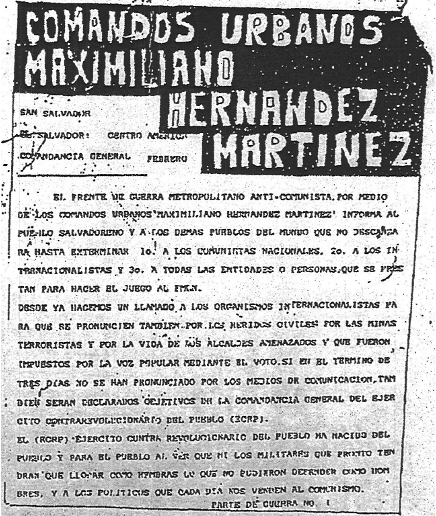
And in El Salvador and Guatemala (late 1970s-early 1990s), the armed forces’ rural “clean-up sweeps” (operaciones de limpieza) left literally nothing alive. In a sort of corollary to Chinese Communist leader Mao Tse-tung’s aphorism outlined in On Guerrilla Warfare that the people are like water and revolutionary troops the fish living in the water, state leaders explained that such extreme action was necessary: We have to drain the sea to kill the fish.
Throughout the region, authoritarian regimes pitched their communist-catching nets broad enough to ensnare wide swaths of society: peasants; members of Indigenous communities; proponents of Judaism, Liberation Theology, human rights, and social justice; students; intellectuals; homosexuals; community leaders; and, of course, armed guerrillas. In some locales, including Chile and Guatemala, “communist” became a euphemism for “Indian,” paving the way for genocidal campaigns against Indigenous communities.
Minnesota
Although a few conservatives, including commentator Bill O’Reilly and Senator Josh Hawley (R-Missouri), are dredging up McCarthy-era rhetoric to charge that Minnesota protest groups are linked to the Chinese Communist Party, it is far more common today for government officials to play the Race Card.
Somalis are one of Trump’s favorite targets. Minnesota has a long and proud history of receiving refugees, including Somalis and other people fleeing from conflicts caused or exacerbated by US military involvement. The state is now the “center of the Somali diaspora.” Minnesota Somalis are educators, medical professionals, police officers, lawyers, owners of restaurants and other businesses, and democratically-elected public officials.
Yet administration officials bandy about patently false statistics to paint Somalis as fraudsters, criminals, “garbage.” U.S. House Majority Whip Tom Emmer (R-MN) falsely claimed that Somalis are responsible for “80% of the crimes being committed in the Twin Cities.” And Trump himself, in a December 2025 cabinet meeting, claimed that “Somalians [sic] ripped off that state [Minnesota] for billions of dollars ... every year, billions of dollars and they contribute nothing. The welfare is, like, 88%. They contribute nothing. I don’t want them in our country, I’ll be honest with you. ... Their country is no good for a reason. Their country stinks.” As he continued, his tirade paralleled his Latin American predecessors who emphasized their nations’ existential emergencies in the face of internal enemies with links to outside forces: “We have to rebuild our country. You know, our country is at a tipping point. We could go bad. We are at a tipping point. ... We could go one way or the other and we’re going to go the wrong way if we keep taking in garbage into our country. [U.S. Congresswoman] Ilhan Omar [D-Minn] is garbage. She’s garbage. Her friends are garbage. These aren’t people that work. ... These are people who do nothing but complain,” Trump said. “When they come from hell and they complain and do nothing but bitch, we don’t want them in our country. Let them go back to where they came from.”
It cannot go unmentioned here that Somalia is a country in East Africa that is largely Muslim, and that Ilhan Omar is a refugee from Somalia, a US citizen, and a Muslim woman. Nor can it go unmentioned that the United States, a “Western nation,” continues to grapple with its complex history of slavery and associated socially-constructed racial, religious, and gender hierarchies.
As for other immigrant groups in Minnesota and beyond, Trump and his allies call them “criminal, illegal aliens,” pedophiles, rapists, murderers, drug lords, people from mental institutions. These are “the roughest people,” just plain “bad people.”
Just as in Latin America, the US federal government has continued to expand its definition of internal enemy so that, now, US citizens who criticize or oppose federal policies are also categorized as criminals. This became especially clear with September’s National Security Presidential Memorandum 7, which claimed the existence of “sophisticated, organized campaigns” of “domestic terrorism” and announced “[a] new law enforcement strategy that investigates all participants in these criminal and terroristic conspiracies—including the organized structures, networks, entities, organizations, funding sources, and predicate actions behind them.” This emboldened federal officials to paint Renee Good and Alex Pretti, two US citizens shot to death by ICE agents in Minneapolis on January 7 and 24, respectively, as domestic terrorists and to launch criminal investigations into them and their family members and networks—rather than the federal agents who pulled the triggers.
MINNESOTA/CENTRAL AMERICA
In both Cold War Latin America and present-day Minnesota, official rhetoric does not match the reality on the ground; it only justifies the state’s surveillance of citizens. And as government agents and their proxies engage in surveillance activities, they cast wide webs of fear and distrust.
Minnesota
ICE spins its web: A black SUV with tinted windows, equipped with automatic license plate scanners, drives around the streets of St. Paul, while drones circle school campuses. Agents turn cell phone cameras on community members, recording their faces and vehicles. Agents follow a friend home, then sit outside their house for hours. A different vehicle is there, waiting, in the morning. Agents join group chats and voice calls, posing as local community members. They dress in civilian clothing—even donning high visibility vests and whistles, typical parts of the “community carer” uniform—and sidle up to parents and neighbors keeping watch outside language immersion daycares, public schools, mosques. Red flags rise when the agents ask odd questions—and too many of them.
Central America
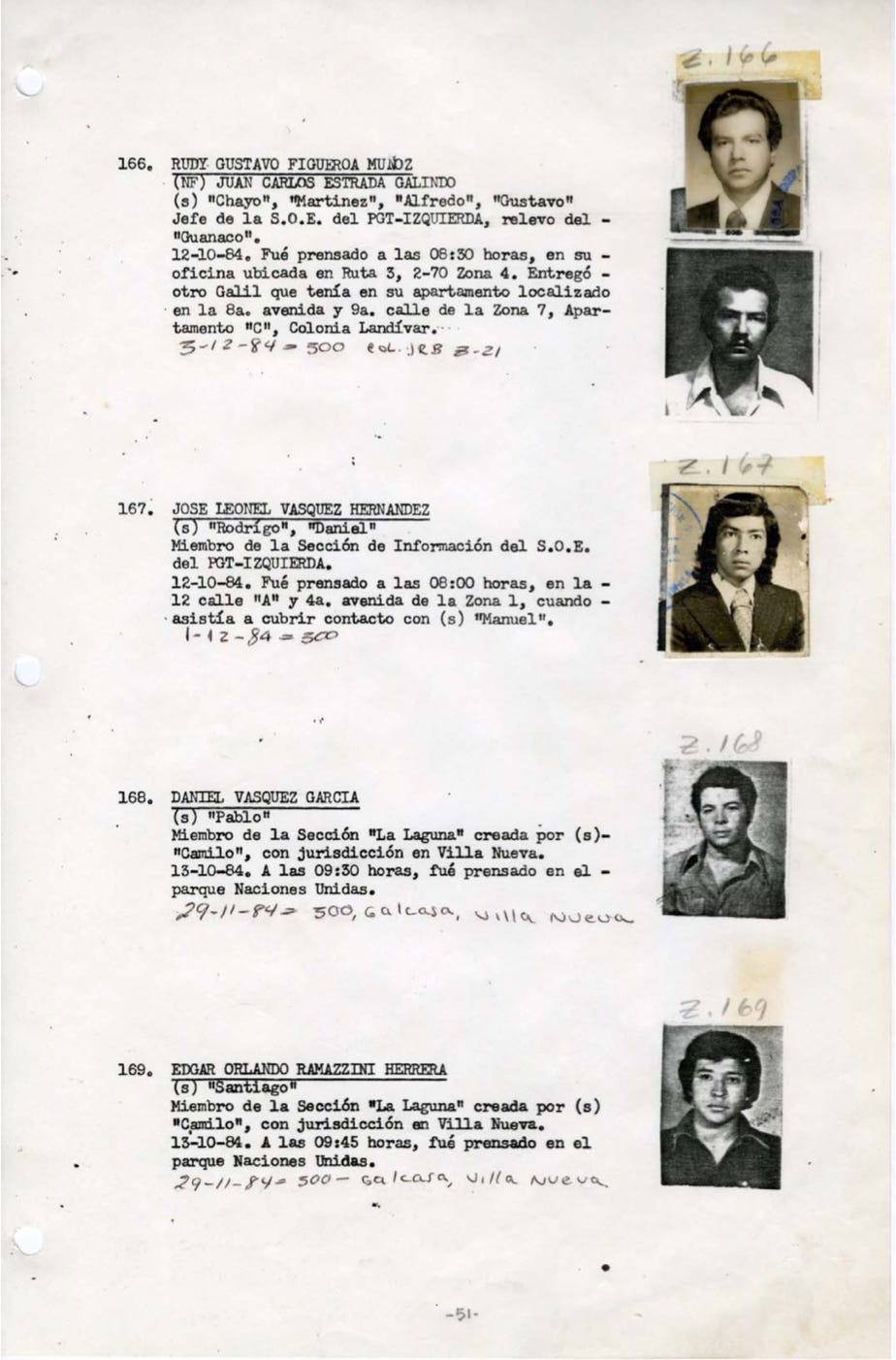
In El Salvador (1980-1992), rural vigilante networks, referred to locally as orejas (ears), conspicuously tracked and reported on community members’ activities. These orejas and their paramilitary associates visited people’s homes and workplaces, aggressively interrogated family members and neighbors about suspected subversive activities. They often left warnings for individuals targeted for elimination: personalized death threat letters, white hands painted on doors (a calling card of sorts from the Mano Blanca death squad). For such reasons, my Salvadoran collaborators referred to their country’s fuerzas de inseguridad, or “insecurity forces.” In Guatemala (1960-1996), state agents systematically tracked suspected subversives over months and years, logging information about them, along with their family members’ workplaces, schools, friends. When I was working at the non-governmental National Security Archive, one leather-bound military log book came into our hands. It was, in essence, an analog spreadsheet, listing hundreds of citizens—from children to octegenarians—who had been abducted and moved through the state’s clandestine prison system. Over weeks we deciphered the log and its codes. “Se le llevó Pancho” (Pancho took him), for example, meant the individual had been killed.
But Minnesota residents have stayed grounded and, in the face of such horror, we have risen into action.
My former student D. admitted to feeling an unnatural “level of vigilance.” And A., a close friend of mine who works for the public school system, called it “a total mind fuck.” Which is precisely the point.
But Minnesota residents have stayed grounded and, in the face of such horror, we have risen into action. We formed grassroots defense patrols to protect ourselves and our neighbors. We developed systems to communicate with each other and to track and document ICE actions. We formed vast mutual aid networks to provide food and rent assistance, rides, and other forms accompaniment. We ally with civil rights attorneys, nonprofit organizations, and neighborhood councils. And this grassroots work, too, shares much in common with cold war-era Latin America which we will explore in “We Keep Us Safe, Part II.” Stay tuned.
Molly Todd is a historian specializing in modern Latin America, transnational human and civil rights activism, and historical memory. She is the founder and principal consultant at Finlinje Studios.