
The views and opinions expressed in this post are solely those of the author and do not necessarily reflect the views, policies, or positions of the Organization of American Historians.
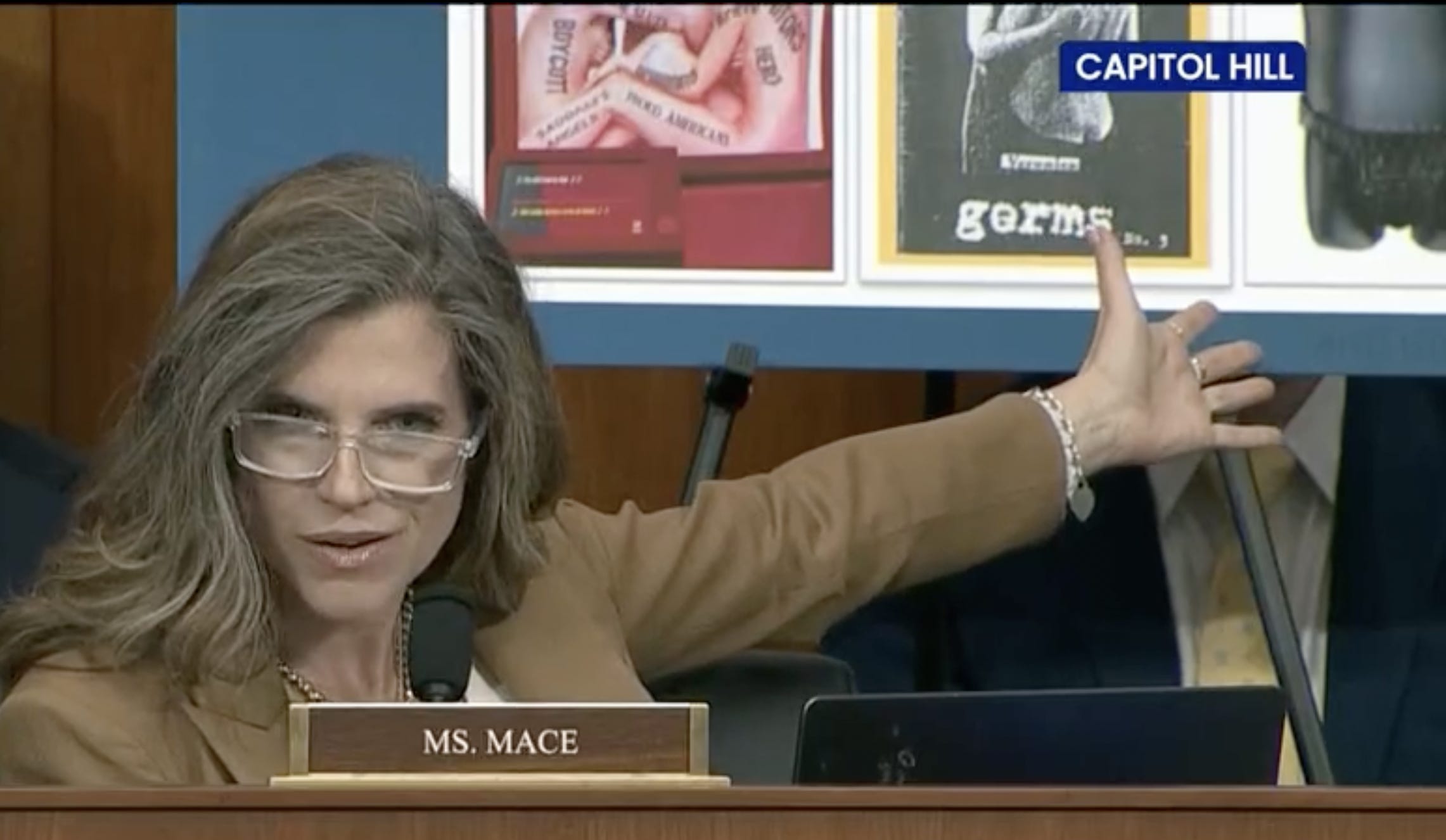
In July, U.S. Representative Nancy Mace of South Carolina attempted to discredit the Smithsonian National Museum of American History (NMAH) and shame its director during a House Oversight subcommittee hearing titled “Rewriting American History: Examining the Smithsonian’s Efforts to Reshape the Past.” Her main “gotcha” moment featured a poster-board with six images taken from Smithsonian exhibits, which she and other Republican Representatives described as sexually explicit, inappropriate for children, and offensive to all.
The House’s July hearings on the Smithsonian and the White House Domestic Policy Council report that triggered the hearings have been criticized on many different levels, but LGBTQ History Month provides us with a good opportunity to focus on the gender confusion, sexual ignorance, and political hypocrisy displayed by Mace and her colleagues.
Mace referred to the items she displayed as “provocative sexual imagery” and accused the NMAH of representing “queer pedophiles.” She suggested that the museum was “sexualizing children” and making them “vulnerable to people that want to rape them.” Indeed she argued that its director had “sexualized” the museum and falsified history by presenting information suggesting that there might be more than two genders. Subcommittee Chairman Tim Burchett (TN) joined his colleague by referencing the posterboard and asking whether “overtly sexual” images were “appropriate for children.”
Setting aside the complicated question of whether Mace and Burchett breached House decorum rules by intentionally and knowingly displaying content that they regarded as obscene, vulgar, and sexually inappropriate, they presumably were aware that recordings of House subcommittee hearings are commonly made available to the general public, including children. Mace and Burchett could have described the images without displaying them, but this would not have been as effective in accomplishing their objectives, which was to sensationalize their accusations against the Smithsonian. Instead, they shared what they termed “provocative sexual imagery” with an audience of children far larger than any Smithsonian exhibit has ever reached.
But let’s consider for a moment the content of the six images that Mace displayed.
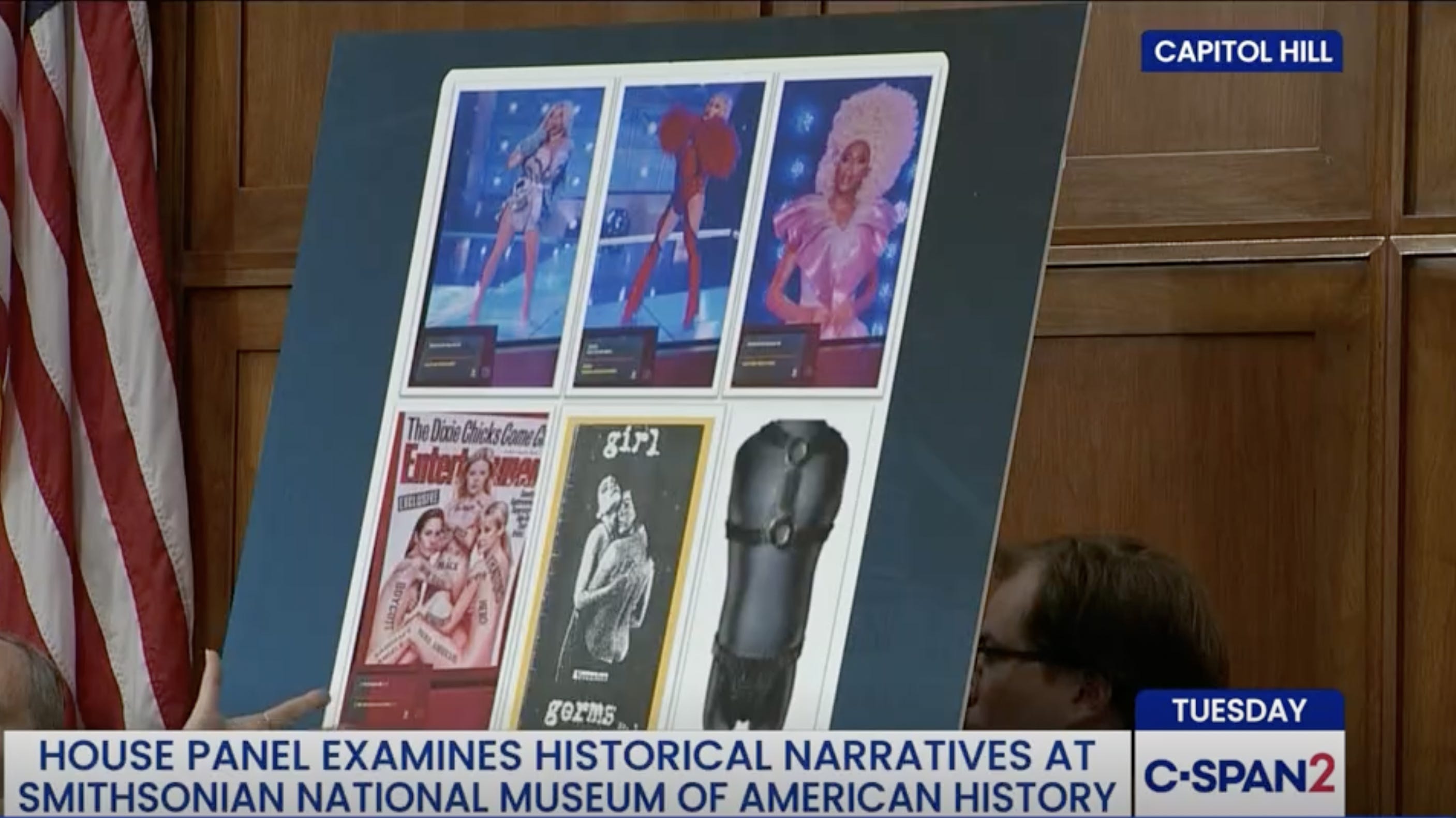
The top row featured images of RuPaul and RuPaul’s Drag Race contestants Kandy Muse and Joey Jay, all of which had appeared in an NMAH exhibit titled Entertainment Nation. I visited the exhibit in March 2025, snapping photographs of Bert and Ernie from Sesame Street, Archie and Edith Bunker’s chairs from All in the Family, Tevye’s costume from Fiddler on the Roof, and the signpost from M*A*S*H. I remember wanting to see more LGBTQ representations.


As for RuPaul, Muse, and Jay, there’s nothing particularly sexually explicit about these images: nothing more sexually revealing than other items commonly found in American museums, nothing that sexualizes children, nothing that encourages rape, and nothing that expresses sorrow for men accused of sexual violence (as President Trump did recently). If Mace wants these three images to be censored because they are sexually explicit, would she similarly want to censor representations of Marilyn Monroe in gorgeous outfits, Superman’s crotch bulge, First Lady decolletage, and Arnold Schwarzenegger posing in trunks?
Before her political allies succeed in banning all college and university classes on gender and sexuality, Mace may want to take an introductory course to brush up on her categories of analysis and improve her ability to distinguish between gender and sexuality. Hopefully that will prepare her to make pronouncements on whether the Trump administration should stop displaying shirtless images of Pete Hegseth’s muscles and tattoos, nearly naked professional wrestlers performing on the White House lawn, and sexualized United Fighting Championship Ring Girls, all of which seem to be erotically appealing to MAGA supporters.
The bottom left image on Mace’s poster board showcased a 2003 cover of Entertainment Weekly featuring The Dixie Chicks, a three-person musical group that later changed its name to The Chicks. Published in the aftermath of the group’s controversial critical comments about the Iraq War, for which they were lambasted in conservative media, the cover depicted the three women without clothing but with hands, arms, and legs covering their breasts and genitalia and keywords printed on their skin. The words labeled them fearless, opinionated, brave, patriots, and proud Americans while also invoking the hate speech used by their enemies by calling them big mouths, Dixie sluts, Saddam’s angels, and traitors.
It’s not clear what legal definition of “sexually explicit” Mace was using in suggesting that the Smithsonian should not have displayed this image, but U.S. Code Section 2256 of Title 18 indicates that “sexually explicit conduct means actual or simulated: sexual intercourse, bestiality, masturbation, sadistic or masochistic abuse, or lascivious exhibition of the genitals or pubic area.” I don’t know about you, but I see more sexually explicit content on highway billboards, magazine advertisements, oceanside beaches, and family-oriented television programs.
The fifth image on Mace’s poster board displayed the 1991 cover of the third issue of Girl Germs, a zine published by Allison Wolfe and Molly Neuman. The photograph on the cover appears to depict two shirtless women embracing; their breasts are not visible and the two women are not kissing. Do we think this is more sexually explicit than the kisses that President Trump has bestowed on Maricopa County Sheriff Joe Arpaio and his repeated expressions of desire for handsome and hunky men?
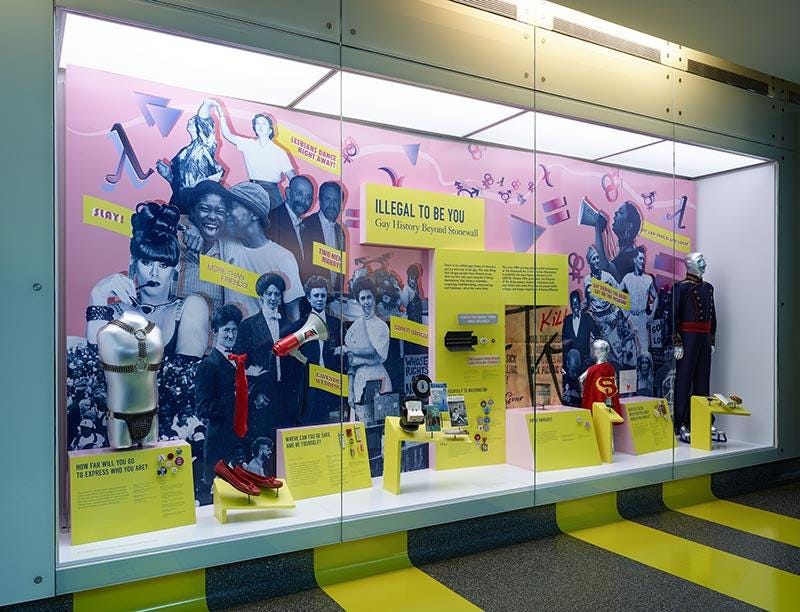
The final image appeared in a temporary NMAH history exhibit titled, “Illegal to Be You: Gay History Beyond Stonewall.” It has been described as a crotch harness but actually is a chest harness with a crotch harness on a torso mannequin with no arms or legs. The exhibit opened in 2019 and closed in 2021. Mace and her cronies deliberately removed the harnessed mannequin from its original context.
Curiously, Representative Mace has been known to wear skin-tight leather outfits on her podcast, “Get Maced,” so she might want to counsel her pot to stop calling the Smithsonian’s kettle black. Similar gear has been worn by characters in Avatar, Game of Thrones, and Star Trek. She also should ask her intro gender and sexuality studies professor to teach a class about the advanced rituals of consent that have been developed in leather and BDSM cultures.
Political responses to and media comments on the Trump administration’s attacks on the Smithsonian have understandably focused on historical standards, institutional independence, and government overreach, but there’s been an unfortunate lack of attention by political commentators and media pundits to the use of sexual shaming as a technology of power in the current context. There’s also been a collective failure to understand that in this case sexual shaming functions as a coded way to attack LGBTQ+ people, places, positions, and pursuits.
In truth, Trump, Mace, and their allies would like nothing better than to purge all representations of LGBTQ+ lives, loves, and lusts from the public sphere, and if they could extend the purge to the private sphere, they would happily do so. Don’t be taken in by facile, fake, and false expressions of concern about child welfare and sexual morality. LGBTQ+ bodies are part of the body politic.
Marc Stein is the Jamie and Phyllis Pasker Professor of U.S. History and Constitutional Law at San Francisco State University, the author of Bicentennial: A Revolutionary History of the 1970s, and the 2026-27 president of the Organization of American Historians.