For the White House, Impartiality Is Out. Ideology Is In.
by Christopher Sellers

The views and opinions expressed in this post are solely those of the author and do not necessarily reflect the views, policies, or positions of the Organization of American Historians.
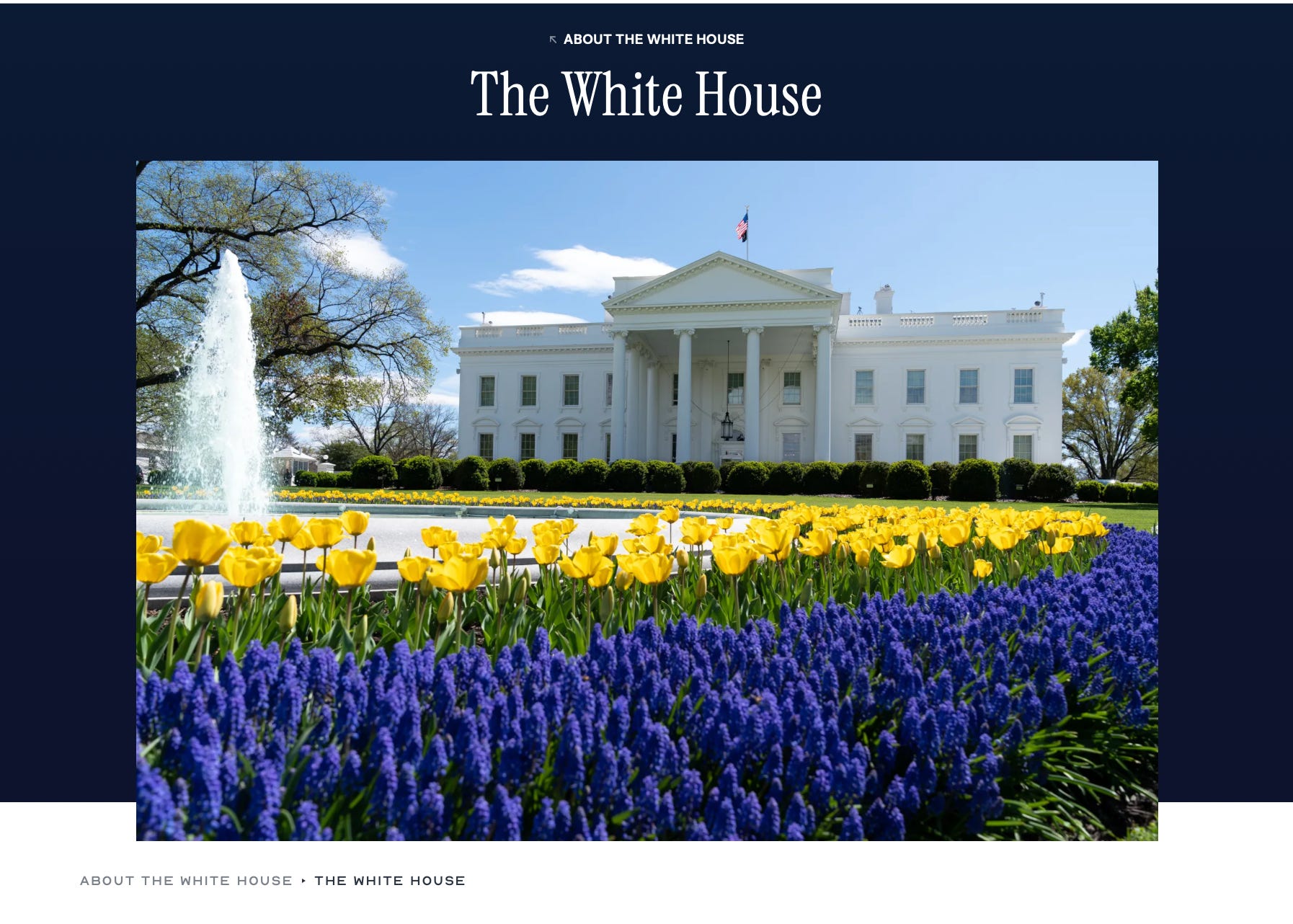
If you search for Calvin Coolidge on today’s White House website, you'll find he renovated its upper floors and is quoted in a Trump proclamation: “the business of America is business.” If you look for Theodore Roosevelt, you'll learn that he built the West Wing and (in an official statement celebrating his birthday) that he went after corruption, protected public lands, and wielded a big stick (while speaking softly). But now search for Bill Clinton. How does the official White House history timeline spotlight his tenure there? With a singular event: the Monica Lewinsky scandal.
Since its inception, the White House website has served both as presidential “bully pulpit” and as a showcase for the history of that renowned building and its occupants. The digital rewrite of White House history by the Trump 2.0 administration offers a foretaste of what may be in store for the many federal museums and parks as it moves to recast how America’s history is presented for the upcoming 250th anniversary of our nation. To tell from the Trump White House’s website, its new slant on America’s past has abandoned long established conventions that coated presidential history-telling with at least a patina of impartiality. Instead, Trump 2.0’s version of White House history succumbs to a stridency dictated by its own ideological blinders.
Since the Worldwide Web coalesced in the 1990s, every new set of occupants has created its own website for the White House and its history, since preserved here on a National Archives site. From Bill Clinton and George W. Bush, through Barack Obama into the Joe Biden years, the history on White House webpages has followed a similar formula. Typically, visitors found short biographies for all the presidents and first ladies, often drawn from publications of the White House Historical Association, a venerable and militantly non-partisan organization. Each of the building’s iconic rooms had a devoted page, from the Oval Office to those designated by color (Blue, Green, Red) to the East Wing. Photos and features invariably emphasized the White House meetings and events of the current president. The George W. Bush administration was the last to interweave these with comparable materials from predecessors Democratic and Republican alike.
After 2008, historical contents slipped down into submenus or disappeared altogether. The sites of the Obama and first Trump White Houses retained the biographies of presidents and first ladies and the same one-page history of “the White House building.” But with Trump 1.0, the virtual tours of earlier White House websites vanished, and in the Biden years, history and tours became even harder to find.
The White House website of the second Trump administration has dramatically reversed that trend, moving carefully curated versions of the past back into the spotlight. Anticipating America’s 250th anniversary in July 2026, it brings back biographies of “Founding Fathers” and “Ladies” alongside plain-vanilla timelines of wars and early nation-building developed by a White House task force for 250th in partnership with Hillsdale College. This “small, Christian, liberal arts college” has since 2021 been promoting explicitly conservative K-12 lesson plans for American history, which have been taken up by conservative governors and school boards even while coming under fire from many professional historians for their distortions and “numerous flaws.” The White House’s elevation of Hillsdale’s “1776 curriculum” onto its own website magnifies those flaws, never broaching the slave-holding that would later provoke a Civil War and includes a page gesturing to Christian nationalism: “America Prays.”
A section “About the White House” opens another even more meticulously self-serving window on the past. The overriding purpose appears to be countering widespread concerns about the administration’s cavalier attitude toward architectural legacies stirred by its peremptory razing of the East Wing. The resulting narrative, Trump 2.0’s version of the White House’s past, breaks with all previous administrations’ history-telling in two fundamental ways.
First, its timeline heavily prioritizes change over continuity. Instead of recounting the lengthy string of occupants, decisions, and events that happened within famous rooms like the Oval Office, this version of its history offers a timeline of architectural changes made in the building itself. Ironically for an administration pledged to conservativism, its historical narrative simply ignores any long-standing heritage borne by this building and its chambers, resting instead on a steady stream of architectural transformations.
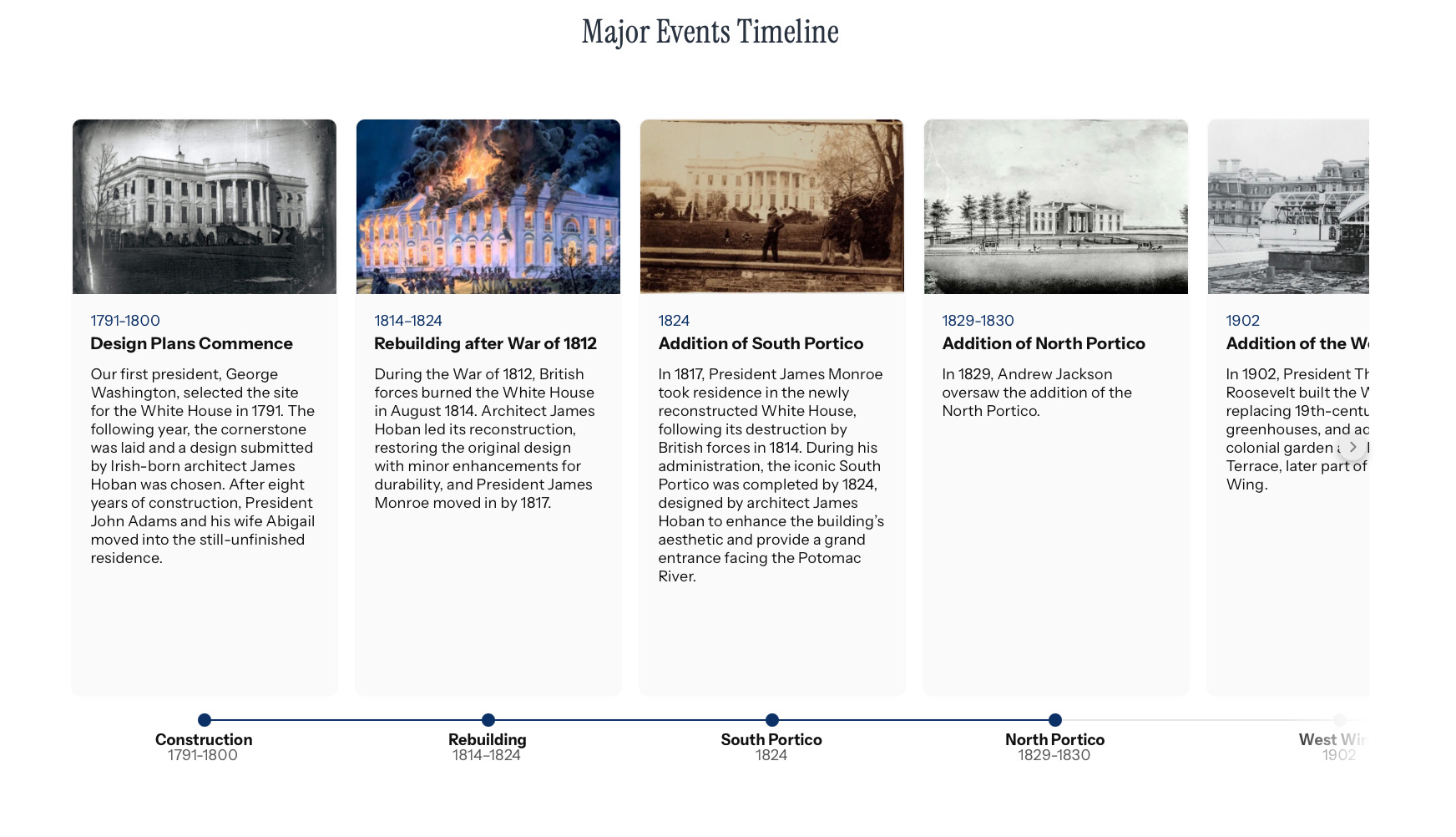
And second, when drawing nearer to the present, Trump 2.0’s history writers abandon any pretense of even-handedness. A timeline of “Major Events” in White House history walks through the building’s first 150 years, up to Richard Nixon, describing significant architectural changes undertaken by successive presidencies, including both Democrats and Republicans without mention of party. Then, leaping over the Gerald Ford, Ronald Reagan, and George H.W. Bush administrations, the entries take a jarring turn away from the edifice itself. Panels for the three most recent Democratic presidencies feature events pitched as moral failures, with a crudeness more commonly seen in political smear campaigns.
For Bill Clinton, the only spotlight falls on the Monica Lewinsky scandal. His “White House trysts” with intern Lewinsky led to “White House perjury investigations…. [and] fueled impeachment for obstruction.”
Barack Obama’s panel selects out a 2012 visit from the Muslim Brotherhood, calling it “a group that promotes Islamist extremism and has ties to Hamas,” underneath a picture of Obama wearing a turban. Here, we also learn that “the Muslim Brotherhood is a designated terrorist organization by nearly a dozen nations.”
One-term president Joe Biden actually has two “major events” in the timeline, starting with a 2023 discovery of a small bag of cocaine “in the West Wing entrance lobby.” Underneath a picture of a shirtless Hunter Biden smoking and half-asleep in a bathtub, the narrative insinuates how “speculation has pointed” to President Biden’s son as the culprit.
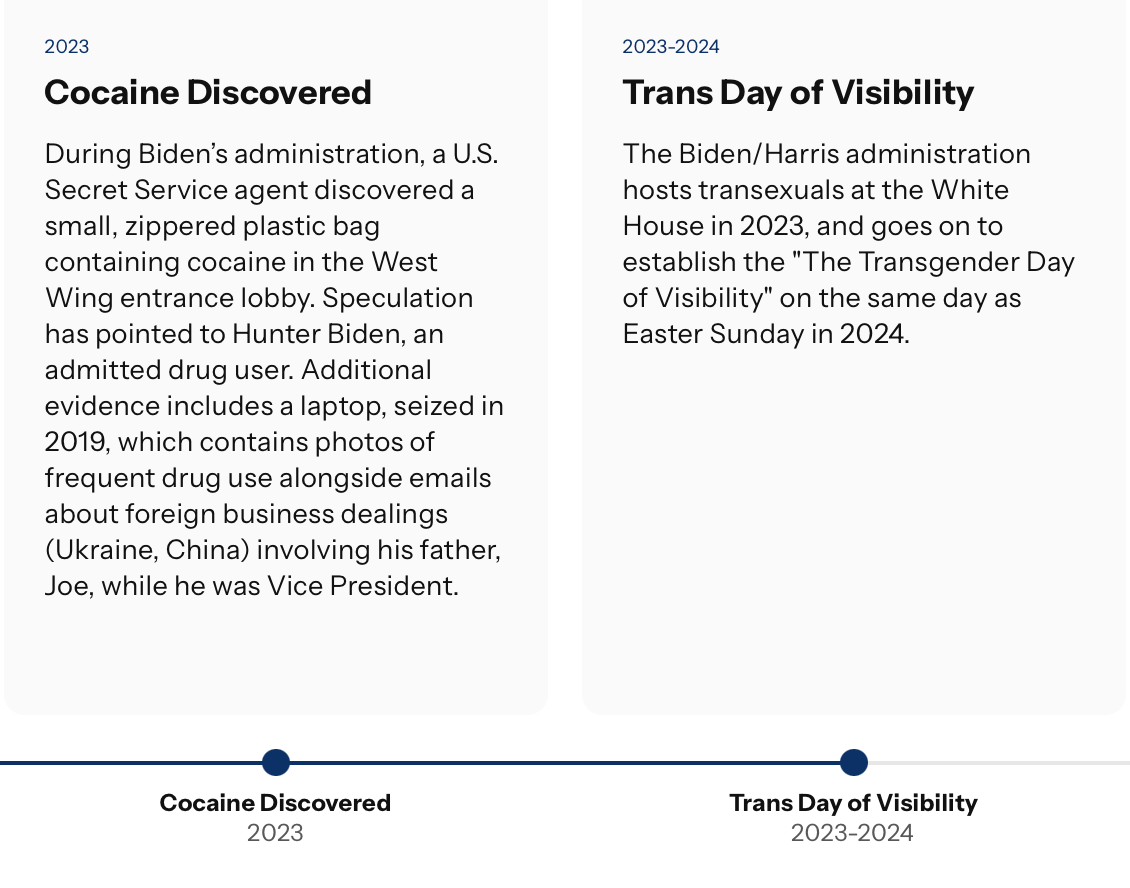
The second singles out Biden’s “host[ing] of transsexuals at the White House” for 2023’s pride month, also the “Transgender Day of Visibility” he honored through president proclamation in 2024, “on the same day as Easter Sunday.” Two illustrations pair Biden’s greeting of an unnamed trans activist (Rose Montoya) with an image showing her shirtless with hands over her breasts.
The lesson here is one familiar to professional historians. Historical interpretations, we know, usually reflect the underlying concerns and creeds of those doing the interpreting. And to be fair, buried among Trump 2.0 website contents are occasional mentions of recent Democratic predecessors that are more favorable: “Clinton-era workfare,” for instance, as a precedent for the Big, Beautiful Bill. But as this timeline highlighted in the website’s menu shows, once any effort at impartiality is abandoned and ideology takes over, the result is caricature: a thin gruel only speaking to the already convinced, and all too close to an episode of “Drunk History.”
The Trump 2.0 White House is now rolling out similar approach to the history on display at the Smithsonian and other museums and historical sites. We have entered an era when the official federal presentation of our nation’s history has become untethered from long-standing conventions of even-handedness, also from any shared sense of our past. In such vertiginous times, battles over the history that grounds us have become ever more pivotal to those over America’s present and future.
Christopher Sellers is a historian of American and environmental history at Stony Brook University, currently working with the History, Archives and Records Preservation Project (HARPP) and the Environmental Data and Governance Initiative (EDGI). His latest book is Race and the Greening of Atlanta: Inequality, Democracy, and Environmental Politics in an Ascendant Metropolis (University of Georgia Press, 2023).
A good way to counter these narratives is to send a history book to a friend: https://postusphotobook.com